


RESILIENCE BY DESIGN
Most innovation is judged on whether it is new, efficient or compliant. Resilience by Design adds a deeper baseline: is it in tune with the people and living systems it depends on, now and for generations to come?
Free Resonance Baseline · Your answers stay in your browser
Sustainability is measured everywhere, except where it is decided.
Up to 80% of an innovation's impact is fixed during design. Yet most sustainability measures arrive afterwards: reports look back, certificates come at the end, and circularity metrics can close loops that shouldn't exist at all.
Resilience by Design moves the question to the start. Before we ask whether something is new, efficient or compliant, we ask whether it serves life. When that becomes the baseline, there is far less to repair later. Resilience becomes a design outcome, not a recovery job.
Circularity closes the loop. Resonance asks whether the loop should exist in the first place.
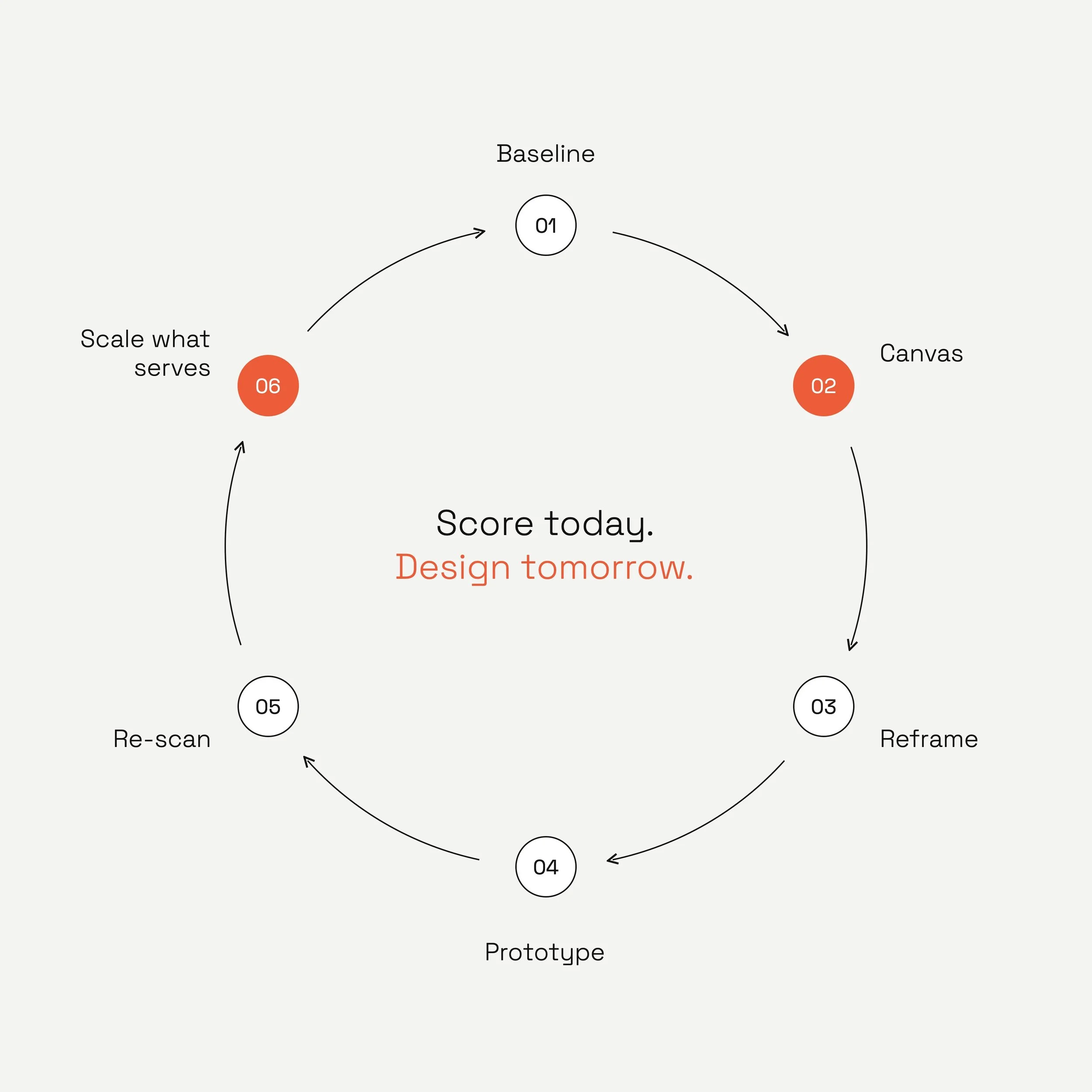
Score today. Design tomorrow.
-
Set the field.
Choose what you're scanning: an innovation, a team, an organisation or your own leadership. Pick your sector, so the scan weighs what matters most there.
-
Score on the Maturity Ladder.
Eight dimensions, each scored from Unaware to Regenerative. Compliance is level 2: the floor, not the goal.
-
Get coached as you go.
After each answer you see what the next level looks like. If your answers contradict each other, the scan asks you about it.
-
Design it up.
Choose up to two dimensions, describe what you would change, and see your designed profile next to today's baseline.
Innovation needs a new baseline. Does it serve life?
Most innovation is judged on whether it is new, efficient or compliant. Resonance adds a deeper baseline: is it in tune with the people and living systems it depends on?
Set a resonance baseline for an innovation, a strategy, a team or your own leadership. As you answer, the scan shows what the next level looks like, so the gaps become design challenges. Re-scan after each iteration to see what moved.
Eight dimensions, scored on the Resonance Maturity Ladder and weighted for your sector. You get a Resonance Index, design challenges and a pre-filled Resonance Alignment Canvas. Your answers stay in your own browser.
What are you scanning?
ContextBefore you begin: how life-serving does it feel right now? We'll compare this with your answers.
Tell us about your project.
Two minutes. Every step that follows is tailored to these answers. Nothing leaves your browser.
What is it?What would you change in the idea?
Pick up to two dimensions to design up. Describe the change, and see the designed profile next to today's baseline.
This is design intent, not a score. Your baseline stays honest. The higher score counts once the change is built in and you re-scan.
Combine results
Resonance lives in the field between people. Where perspectives differ, there is a conversation worth having.
Ask each person to complete the scan on their own and send you their result code (shown at the bottom of their results). Paste one code per line below.
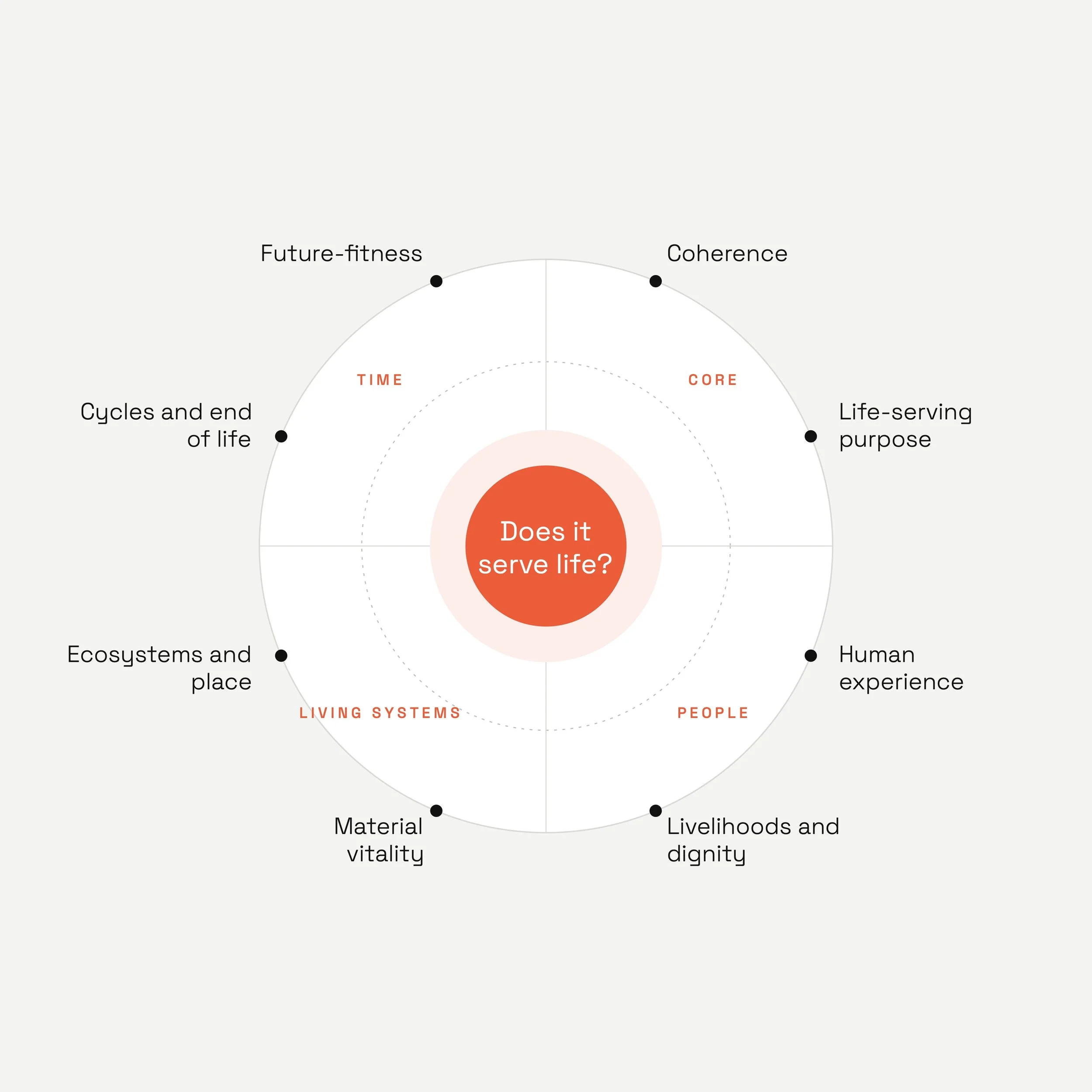
Eight questions every innovation should be able to answer.
Core. Coherence: without the adjectives, does the noun still hold? Life-serving purpose: is serving life the first criterion, or the last check?
People. Human experience: does it calm and clarify the people who make and use it? Livelihoods and dignity: can everyone in the value chain live well?
Living systems. Material vitality: is it non-toxic and safe to return to the earth? Ecosystems and place: does it leave its place more alive?
Time. Cycles and end of life: should this loop exist at all? Future-fitness: will it still make sense seven generations from now?
Each dimension is anchored in recognised frameworks, including CSRD, ISO 56001, ISO 59000, planetary boundaries and living-wage benchmarks. Resilience by Design draws on them without claiming affiliation or certification.A baseline you can measure, track and design from.
-
Resonance Index.
One score out of 100 for how far it serves life, weighted for your sector. 50 means compliant. "Why this score" shows exactly how it is built.
-
Harmony and Confidence.
How evenly the dimensions score, and how well your answers are backed by evidence.
-
Strengths and tensions.
Named pa"erns such as "Loops closed, life ignored", red lines to fix first, and blind spots to explore.
-
Design challenges.
Your weakest dimensions turned into "How might we…" briefs.
-
A pre-filled Resonance Alignment Canvas.
Ready to print and work on with your team.
-
A one-page brief.
Your scores, design challenges and an action plan on one A4 page, for a board or sponsor.
-
Tracking.
Save your baseline and re-scan after each iteration to see what moved. Teams can combine their results to see where perspectives differ.
For anyone shaping what comes next.
Innovation teams: test an idea, product, service or strategy while it can still change.
Leadership teams: align on what "serving life" means in your decisions, and see where you differ.
Organisations: set a baseline for a portfolio or a transformation, and track it over time.
Leaders and professionals: reflect on your own choices and leadership.
It works across sectors, from health, education and the public sector to fashion, food, technology, finance and the built environment.A scan opens the question. Change needs a conversation.
Human by Design helps leaders, teams and organisations turn a resonance baseline into strategy, innovation and lasting change. That might be an in-company session that turns your design challenges into prototypes, an evidenced Resonance Index assessment, or one of our programmes, such as The Innovation Shift and Beyond Resilience.
Two steps:
Resonance Baseline · free. Your self-assessed Resonance Index, in minutes.
Resonance Index assessment · with Human by Design. Your Index verified with documents and indicators, so you can report on it and scale what serves.
Frequently Asked Questions
-
Yes. There's no sign-up. If you'd like your report by email, you can leave your address, but you don't have to.
-
They stay on your device. The tool runs entirely in your browser and doesn't send your answers to us or to anyone else. If you choose "Save as baseline", the result is kept only in that browser. If you ask for your report by email, the tool opens your own email app with your summary, and nothing is sent until you press send.
-
The quick scan takes about four minutes. The deep scan takes around fifteen minutes and gives a more detailed picture.
-
No. The scan gives a self-assessed Resonance Index, a reflective baseline for innovation. It doesn't replace a life-cycle assessment, a supply-chain audit or professional advice. For an evidenced Resonance Index assessment, get in touch.
-
So the gaps become design directions straight away. Always score today's reality. The advice shows how to change the idea, not the answer.
-
Ask everyone to take the scan on their own, with the same context and sector. Each person gets a short result code that contains only their answers, never their name. Paste the codes into "Combine team results" to see the shared baseline and where perspectives differ most.
-
The Resonance Baseline is the free scan. The Resonance Index is the score it gives you, out of 100. In the scan, your Index is self-assessed: it reflects your own answers. In a Resonance Index assessment, Human by Design verifies it with documents and indicators.