

Re-grounding.
Why real innovation begins by listening beneath the noise.
There are times when forward motion is no longer courageous. And there are times, like this one, when the most radical act can be to stop, lower the noise and feel for the ground again.
Re-grounding is recalibration.
A return to the conditions that make movement meaningful.

The signal beneath the signal.
In innovation courses, MBA modules and professional trainings I teach at Maastricht University, a pattern has become impossible to ignore, especially in recent years. Beneath the intellectual sharpness and technical fluency, something else is present: moral tension, quiet fatigue and an unspoken uncertainty about whether the systems participants are asked to improve are still fundamentally sound.
Across sectors, this same convergence is becoming visible.
Burnout and disengagement are not a fringe phenomena. Gallup estimates that global productivity losses due to disengagement and burnout now amount to $8.8 trillion annually, close to 9% of global GDP.
Environmental degradation is not an abstract future cost. OECD analyses show that environmental-related damage, health impacts, and infrastructure stress are already suppressing economic output now.
Capital itself is shifting posture. Over $30 trillion is managed under ESG-related strategies as risk mitigation. Long-term fragility is being priced in.
These are hard metrics. Yet work by computer scientist and linguist Clif High suggests that large-scale patterns in human language and sentiment can surface early indications of collective stress and transition before these become visible in formal metrics or strategic indicators. In my real-world observation across organisations and executive education, this is precisely what becomes visible: long before dashboards turn red or strategies are questioned, people’s language, behaviour and bodies already register the strain, signalling collective stress well ahead of formal recognition, it is carried at a personal level.
Innovation’s hidden flaw
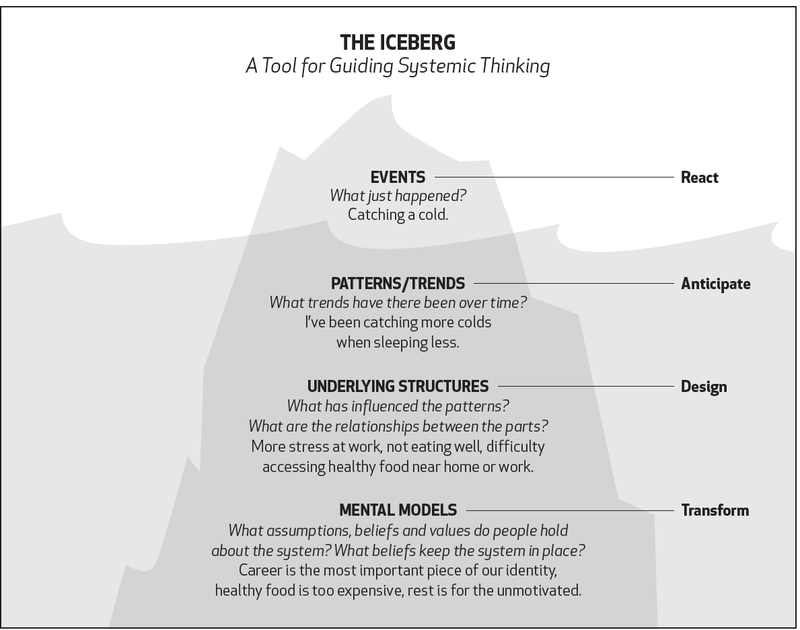
Most innovation efforts fail quietly, not because of poor execution, but because of an unexamined starting point.
They begin with questions like:
How do we grow?
How do we scale?
How do we remain competitive?
Rarely do they begin with:
What are we standing on?
What must not be violated?
What are we already borrowing from the future?
The architect Buckminster Fuller once wrote:
“You never change things by fighting the existing reality. To change something, build a new model that makes the existing model obsolete.”
Fuller did not say it lightly: the ground you choose shapes everything that follows.
What is often missed is this:
Every model rests on a baseline.
If that baseline treats people as infinitely adaptable, nature as infinitely absorbent and time as infinitely forgiving. No amount of innovation will make it viable.
Re-grounding is the act of choosing a grounded baseline before the model is built.

Before purpose. Before strategy
Purpose has become fashionable.
Re-grounding is less so.
In my experience, whether in executive trainings or strategic labs with organisations, purpose often shows up early in the conversation. It arrives in mission statements and ambition decks with earnest intent. People want to do the right thing. They want their work to matter.
Yet the true weight of purpose reveals itself when it becomes a North Star and boundary that holds. In literally countless conversations with professionals across all levels, particularly when we explore how innovation is integrated into the organisation, I’ve heard this articulated with striking clarity:
“Our purpose sounds right in presentations, but it isn’t embodied in leadership behaviour or translated into the strategy that actually guides decisions.”
This gap is not a failure of intent.
It is a failure of grounding.
When purpose is not embodied by leadership, it cannot anchor behaviour. When it is not translated into strategy, it cannot shape choices under pressure. And when it cannot shape choices, it quietly loses credibility. Purpose becomes decorative rather than decisive. Strategy adapts, rather than coheres. Execution becomes exhausting, as people compensate for misalignment instead of acting from clarity.
Re-grounding purpose is not about better language or sharper statements. It is about allowing purpose to carry weight—about letting it constrain choices, reveal trade-offs, and hold when conditions become uncomfortable.
Listening as structural discipline
Re-grounding requires a form of listening that most performance cultures have unlearned.
Not listening for confirmation. Not listening for opportunities. But listening for strain.
Where are people compensating for poor design?
Where does complexity exceed sense-making capacity?
Where do incentives contradict stated values?
Where are short-term wins creating long-term erosion?
This is how purpose gains substance.
This is how it moves from aspiration to boundary.
The systems thinker Donella Meadows observed:
“The least obvious part of the system, its function or purpose, is often the most crucial determinant of the system’s behaviour.”
Learning to listen at this level; below metrics, below narratives, below urgency, is what allows purpose to stop floating above the organisation and begin shaping it from within.
Only then does purpose become something leadership embodies, strategy carries and people can trust when it matters most.
What years inside systems teach you
After years of working with executives, public institutions, innovators and educators, one pattern becomes impossible to ignore.
Most people are not resisting change.
They are tired of compensating for incoherence.
I have sat in rooms where:
leaders carry responsibility without adequate reflection space
teams are asked to move faster while meaning erodes
innovation is celebrated while recovery is quietly discouraged
What strikes me is the absence of ground. People sense it long before they can name it.
Re-grounding begins with relief:
“Finally, we’re allowed to ask this.”
Winter work
There is a reason many traditions associate wisdom with seasons.
Winter consolidates.
Roots deepen.
Structures strengthen invisibly.
Before the next movement, there is value in pausing long enough to hear what usually gets drowned out. In reflection and stillness, intuition is given room to surface as a refined form of intelligence shaped by lived experience, pattern recognition and deep knowing. When attention settles, signals become clearer. In that space, misalignments reveal themselves without force, and direction emerges without urgency. This is winter work too: creating enough inner quiet for what truly matters to make itself known.
In organisational life, winter work looks like:
questioning assumptions
letting go of practices that no longer serve
redesigning pace, not just priorities
restoring alignment between what is said and what is rewarded
These are not soft activities.
They determine whether spring growth will gain momentum and durably.
When re-grounding becomes the soil on which purpose, strategy, and action meet, organisations begin to move not just with momentum, but with meaning that endures.

About the Author
Mikhaël Akasha is a transformational leader working at the intersection of systemic strategy, life-serving innovation, and human development. As founder of Human by Design and as Innovation Lead and Lecturer at Maastricht University, he supports organisations in translating purpose into practical strategy, applied innovation, and learning journeys that endure over time.
Bridging decades of work with global organisations, academic leadership programmes, and ancient wisdom traditions, his work invites leaders to let clarity within shape conscious action and to design innovation that truly serves life.