
Beyond Circular: Designing Systems That Remain Viable
Circularity has improved how we manage what already exists, but it does not determine what should exist in the first place. Designing systems that remain viable requires a shift from optimising flows to shaping decisions. This means prioritising material integrity, aligning incentives with long-term consequences, and taking responsibility at the point of creation. Organisations do not operate outside the systems they build; they operate within the outcomes of their own choices. The future will favour those who design with this awareness from the outset, creating systems that can sustain themselves rather than systems that require continuous correction.For over a decade, circularity has been positioned as a solution to the environmental and economic pressures shaping our time. The premise is clear: eliminate waste, extend material life, and regenerate natural systems. Yet the data presents a different reality. The global economy is becoming less circular, not more, with estimates from Circle Economy showing a decline in circularity in recent years, even as sustainability commitments increase.
I have worked within this tension across different domains, from global creative and innovation roles to executive education and organisational transformation. Over time, a consistent pattern becomes visible. Organisations are becoming more efficient at improving systems that may not be viable to begin with.
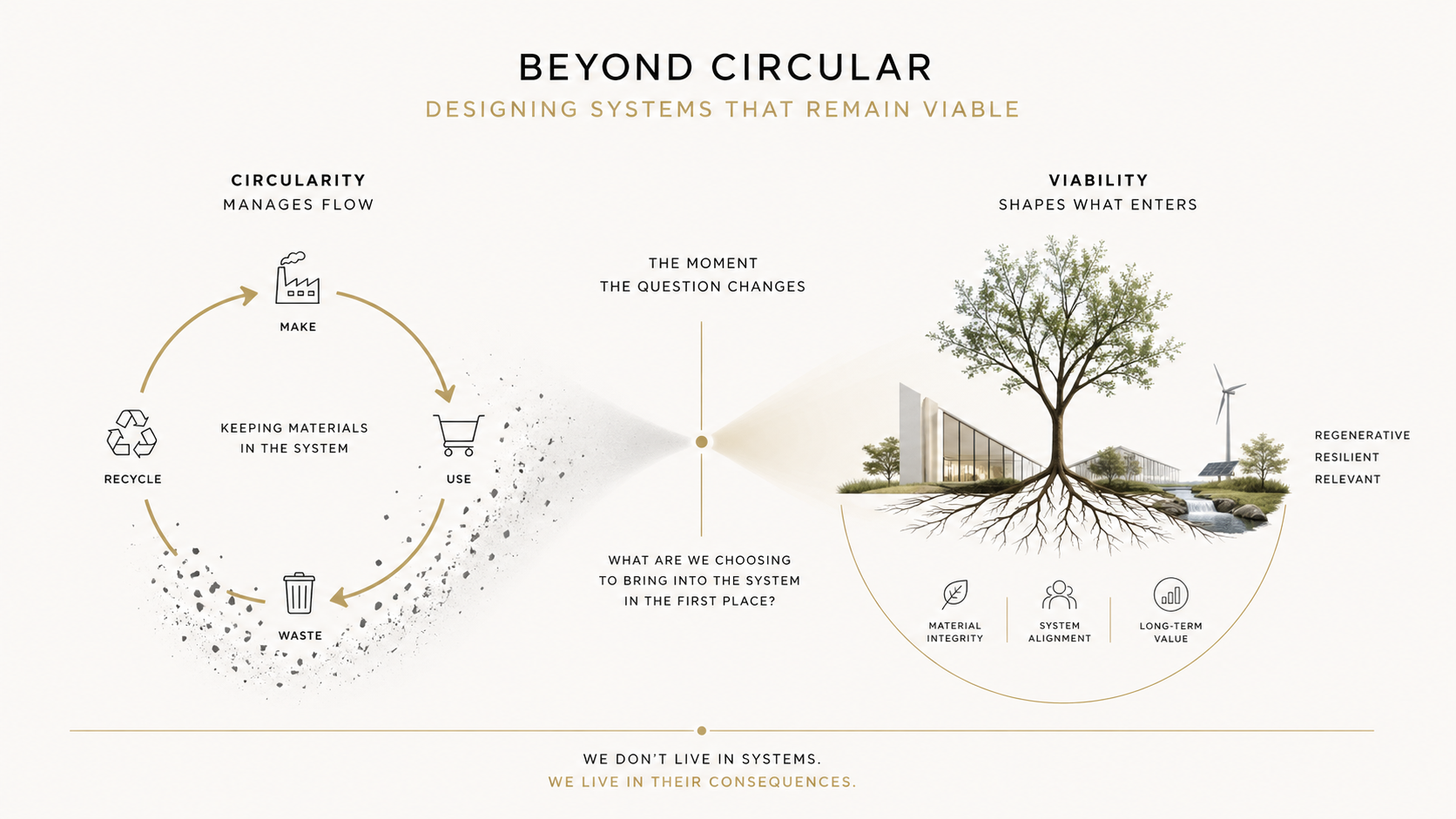
Circularity focuses on flow. It addresses how materials can remain in use. However, it rarely addresses the more fundamental question that sits at the beginning of any system: whether something should exist in its current form at all.
This is where the shift begins.
The Moment the Question Changes
Across my work in innovation, executive education, and organisational transformation, sustainability conversations often begin with optimisation. The focus is typically on reducing waste, improving efficiency, extending product lifecycles, or making processes more circular.
These are necessary steps. However, they do not fully address how long-term consequences are created.
A more fundamental shift occurs when the question moves upstream. Instead of only asking how to reduce the impact of what already exists, organisations begin to ask what they are choosing to bring into the system in the first place.
This shift changes the nature of decision-making. It places responsibility at the point of creation rather than correction. It directs attention to material selection, system design, and the assumptions embedded in business models.
It also reveals a structural dynamic. Decisions are often made locally, while consequences accumulate systemically over time.
This is where a principle becomes tangible:
“An organisation lives inside the consequences it creates.”
Circularity, in this context is incomplete.
Circulating Harm More Efficiently

A system can be circular and still be extractive. A material can be recyclable and still be harmful. A product can be optimised and still be unnecessary.
Research from United Nations Environment Programme shows that global material extraction has more than tripled since 1970 and is responsible for over 90% of biodiversity loss and water stress. Despite improvements in recycling and circular strategies, the total volume of materials entering the global economy continues to increase.
This highlights a structural limitation. Circularity often operates within the logic of the system it is trying to improve. It increases efficiency, but it does not always challenge whether the system itself is viable over time.
In practice, this leads to a recurring pattern. Organisations optimise packaging, supply chains, or product lifecycles, while the underlying model that generates negative externalities remains unchanged.
At this point, a second principle becomes relevant:
“If your materials cannot safely return to biology, your strategy cannot safely return to the future.”
From Circularity to Integrity
Moving beyond circularity does not require abandoning it. It requires placing it within a broader framework that prioritises material integrity.
Material integrity focuses on the composition of what enters the system. It asks whether materials are safe, whether they can return to biological or technical cycles without degradation, and whether their extraction and processing create hidden externalities.
This perspective aligns with fields such as Cradle to Cradle design and Industrial Ecology. These disciplines emphasise that materials should either safely re-enter natural systems or remain within closed technical cycles without loss of quality.
In practice, these principles are often applied too late in the process. The most significant impact occurs when these considerations are integrated at the beginning of decision-making.
When organisations begin to question not only how they create, but what they create and why, the range of possible solutions expands. Some products are redesigned. Others are removed. New business models emerge that were previously not considered.
At this stage, sustainability shifts from a reporting function to a core decision discipline.
Designing for Viability.
Viability extends beyond environmental performance. It refers to the ability of a system to sustain itself economically, socially, and ecologically over time without accumulating unresolved costs.
Research in systems theory shows that systems with aligned components are more resilient and adaptive. When purpose, incentives, and operations reinforce each other, organisations are better able to respond to disruption.
In contrast, misaligned systems accumulate hidden risks. These risks eventually surface as regulatory pressure, supply chain instability, or reputational damage.
This dynamic is already visible. Increasing ESG requirements, stricter regulation, and shifting market expectations indicate that existing systems are approaching structural limits. In this context, viability becomes a practical requirement rather than an abstract concept.
Decision Architecture and Long-Term Value
If circularity focuses on outputs, viability begins with decisions.
Every product, service, or system is shaped by a series of choices related to materials, design, cost, and trade-offs. These choices determine long-term outcomes, often beyond the timeframe in which they are made.
Positioning sustainability as decision architecture means integrating long-term consequences into these choices from the outset.
This includes embedding lifecycle thinking early in product development, aligning incentives with long-term value creation, and designing governance structures that prioritise material and system integrity.
Evidence from McKinsey & Company shows that companies with integrated sustainability strategies can improve operational efficiency, reduce risk exposure, and strengthen resilience.
The deeper advantage, however, lies in coherence. When decisions are aligned with long-term viability, organisations reduce internal friction and improve execution.
This is where another principle becomes concrete:
“What you call a material choice today will be accounted for as a financial consequence tomorrow.”
The Leadership Threshold
At a certain point, frameworks and tools are no longer the primary constraint. Leadership becomes the determining factor.
Designing for viability requires confronting trade-offs that are often deferred. It requires prioritising long-term outcomes over short-term optimisation. It requires aligning strategy, incentives, and execution.
In many organisations, the direction is clear, but progress remains limited. This is not due to a lack of knowledge, but due to structural and cultural inertia.
This dynamic can be summarised as follows:
“The door is open, but culture has trained the organisation not to move.”
Addressing this requires consistent decision-making that aligns with stated priorities.
Designing What Holds
The transition beyond circularity is not about discarding existing approaches. It is about extending them.
Circular principles remain relevant, but they must be integrated into a broader framework that prioritises viability. This requires a shift from managing outputs to shaping inputs, and from reducing harm to preventing it.
The central question changes.
It is no longer sufficient to ask how to make something less harmful. The more relevant question is whether it contributes to a system that can sustain itself over time.
This is a more demanding standard. It requires rethinking materials, business models, and governance structures. It requires making trade-offs explicit and moving from incremental improvement to structural change.
Organisations that design for viability are not only reducing risk. They are building systems that can endure, adapt, and create value without undermining the conditions on which they depend.
In a context of increasing volatility, this is no longer optional. It is foundational.
The future will not be shaped by those who optimise what exists. It will be shaped by those who take responsibility for what is created in the first place.

About the Author
Mikhaël Akasha is a transformational leader working at the intersection of systemic strategy, life-serving innovation, and human development. As founder of Human by Design and as Innovation Lead and Lecturer at Maastricht University, he supports organisations in translating purpose into practical strategy, applied innovation, and learning journeys that endure over time.
Bridging decades of work with global organisations, academic leadership programmes, and ancient wisdom traditions, his work invites leaders to let clarity within shape conscious action and to design innovation that truly serves life.